
Free WA GATE Practice Test Questions
The ASET is the paper test Year 6 students sit for Perth Modern and the other GATE programs. Try Abstract Reasoning and Quantitative Reasoning questions on this page, see how the four tests are timed, and check the dates for the 2028 intake.
The short answer
- The ASET has four tests in this order: Reading Comprehension 35 minutes, Communicating Ideas in Writing 25, Quantitative Reasoning 35 and Abstract Reasoning 20.
- Abstract Reasoning is 35 questions in 20 minutes, under 35 seconds each, and it is the part that gets easier with exposure to the format.
- The ASET is paper and pencil at an assigned test centre, so it is worth doing a full section on paper in one sitting before the day.
- For the 2028 intake, applications close at 6 pm on Friday 5 February 2027 and Year 6 students sit the test on Saturday 6 March 2027.
Many Western Australian families decide about GATE before they have seen an ASET question. The Academic Selective Entrance Test has a particular shape, and a few minutes with practice questions shows it more clearly than a description. Below are free questions in the two reasoning sections, Abstract Reasoning and Quantitative Reasoning. Tap a choice to check it and read the explanation.
Abstract Reasoning: the fast one
Abstract Reasoning is 35 questions in 20 minutes (WA Department of Education ASET Handbook), which is under 35 seconds each. It is non-verbal: there is no content to revise, only a pattern to spot. The skill that matters is seeing the rule quickly and moving on when it won't come, and that depends mostly on having seen the format before.
Look at the sequence of shapes below.
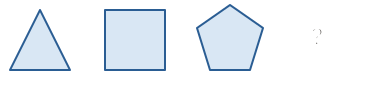
Each shape in the sequence has one more side than the previous shape. What shape comes next?
Look at the sequence of figures below. In each step, the arrow rotates 90 degrees clockwise and the shading alternates between filled and unfilled.

What comes next in the sequence?
Want the full experience?
Practise dozens more questions like these with instant explanations — free, no account needed to start.
There is little to know here and a lot to see. If your child enjoys these, that tells you something useful about the test. If they freeze, the format is usually the reason, and it is the part that gets easier with exposure.
Quantitative Reasoning
Quantitative Reasoning is 35 multiple-choice questions in 35 minutes. It asks for mathematical thinking rather than recall: number relationships, measurement and scale, data, and problems with several steps. The arithmetic is rarely the hard part. The first question below asks for the range of a week of Perth rainfall figures; the second scales a ratio from a school canteen.
A weather station in Perth recorded the rainfall on five days in June: 12 mm, 3 mm, 8 mm, 15 mm, 6 mm.
What is the range of the daily rainfall?
In a school canteen, the ratio of sausage rolls sold to meat pies sold is 4:7. If 32 sausage rolls were sold, how many meat pies were sold?
Want the full experience?
Practise dozens more questions like these with instant explanations — free, no account needed to start.
Practise on paper before the day
The ASET is a paper-and-pencil test, sat at an assigned test centre. Practising on a screen is fine for building the thinking, but in the last weeks it is worth doing a full section with a pencil, on paper, in one sitting. That means marking answers on an answer sheet, watching the clock, and skipping a stubborn question without losing your place. Those are separate skills from knowing the maths, and a screen does not rehearse them.
A shorter place to start is our free printable Quantitative Reasoning practice (PDF): 20 questions written by PrepKit, with worked answers at the back and no sign-up. It is not a past paper, and it is shorter than the section in the test.
About the ASET
The selection process starts in Year 5, the test is sat in Year 6, and placement in Gifted and Talented programs starts in Year 7. The programs include Perth Modern School and academic programs at public secondary schools in metropolitan and regional WA. The test has four timed parts, in this order: Reading Comprehension (35 minutes), Communicating Ideas in Writing (25 minutes), Quantitative Reasoning (35 minutes) and Abstract Reasoning (20 minutes). There is a 10-minute break between the writing test and Quantitative Reasoning. The full section-by-section breakdown is in our ASET format guide.
Dates for the 2028 intake
Applications opened on Tuesday 13 October 2026 and close at 6 pm on Friday 5 February 2027. Year 6 students in Perth metro, Bunbury and Albany sit the test on Saturday 6 March 2027 (WA key dates). Dates can change, so confirm them on the WA Department of Education's Gifted and Talented page rather than on any other summary, including this one.
Perth Modern is not the only good outcome. The format guide above also covers how preferences work across the other GATE schools.
Keep going
- The format in full. WA GATE ASET: test format and how to prepare covers all four sections, how placement works, and preferences.
- A calm routine. Preparing over six months is written for the NSW Selective test, but the weekly rhythm works for a March ASET date too.
Where these facts come from
The test facts in this guide are checked against these pages.
- ASET handbook (PDF) · WA Department of Education, checked 30 Sep 2026
- Gifted and talented · WA Department of Education, checked 30 Sep 2026
- Key dates and application guidelines · WA Department of Education, checked 20 Oct 2026

Choose a section to practise
Try 5 WA Academic Selective Entrance Test practice questions instantly — pick where your child wants to start.
What's in the real WA Academic Selective Entrance Test test
The sections and official timing of the real test, and how many practice questions we have for each.
| Section | Time | Practice questions |
|---|---|---|
| Reading Comprehension | 35 min | 0 |
| Quantitative Reasoning | 35 min | 0 |
| Abstract Reasoning | 20 min | 0 |
| Writing | 25 min | 0 prompts |
Why practise on PrepKit
More than a printable PDF — practice that shows your child exactly where they stand.
Instant feedback on weak topics
Every answer is marked the moment it's tapped, with a full worked explanation. PrepKit highlights the topics your child finds hardest so practice targets what matters.
Parents can see progress
A parent dashboard shows practice activity and per-topic mastery over time — preparation status from what your child has actually practised, not a predicted score.
Short, regular sessions
Ten-minute practice sessions that fit around school — with positive feedback that helps younger children build test-taking confidence over time.
Writing feedback included
Your child writes the timed Writing task on screen. PrepKit marks it against the test's criteria and says what to improve next. Included in full access, from $9.99 a month.
Frequently asked questions
Is the practice test really free?
Does the practice match the real ASET?
When is the ASET for the 2028 intake?
How long is each part of the ASET?
How are GATE places decided?
How much does full access cost?
WA GATE 2028 Application Checklist: Dates, Steps and Schools
Applying for a WA Gifted and Talented program for 2028? Every key date, the steps to apply, and the academic schools with their Year 7 places.
WA GATE ASET: Test Format and How to Prepare
What the WA GATE Academic Selective Entrance Test (ASET) involves — the four sections, timing, Perth Modern entry, and a calm approach to preparing.
Prepare for the Selective Test in 6 Months: A Weekly Plan
A calm, week-by-week six-month plan to prepare for the NSW Selective test — building all four sections steadily without burnout, month by month.
Ready to try it?
Start the free WA Academic Selective Entrance Test practice test now — 5 practice questions, no account needed.